Friday, 17 October 2014

Iodine Tests - Konnyaku Noodle - SAFE!

Today I tested out some Konnyaku noodles. As you can see, very little reaction. About the same amount as, say, a cucumber. This brand probably isn't the best quality as there were some small specks of starch. Not enough starch to be a problem for most people following the NSD. Safer than almonds with skin on (yes the skins have a little starch)


Many of these products coming from China are terribly confused about the contents of their own products. Below we have another packet of Konnyaku that is labelled incorrectly as "Pice Vermicelli". No pice in this, nor is there any rice either. 
Above is the front, and below is the back of the same package. Yes indeed, this is Konnyaku noodle. There is no rice at all. I have seen other products incorrectly labelled as containing yam. A quick iodine test tells the truth. 

Amylopectin - Background for NSD Book Chapter

Here is what I wrote about my experiences with eating Amylopectin. I put this together whilst on a bus to Canberra. There are far fewer distractions for me on a bus, my worst enemies happen to be the TV and computer games. But on the bus I simply put my headphones on, listen to some music that I love, and the words come easily (after about an hour of settling in).  


-- Adaptation --
Sometime around late 2007 I found I could adapt to some problem foods. For example, I was not able to eat onions or garlic due to inulin content. Improper fermentation in my stomach was causing inflammation.  I also had issues with linseed [probably due to lignan or dietary fibre]. However after gradually adding the foods back into my diet, first starting with very small amounts, I found that I could gradually adapt to the foods. Soon they caused caused no trouble at all. 

-- Sticky Rice --
One day whilst eating at a Thai restaurant I just couldn't resist trying a little black sticky rice. It's one of those things I used to really really love eating. Even though it was just one or two teaspoons full, I should have reacted.. Well, I would have if this was normal rice. Months passed and eventually I again remembered my love for Thai black sticky rice. This time, remembering my last encounter, I was much more brave and ate quite a decent amount. Still no reaction! What on earth was happening?! 

In late 2011, around November and December, I noticed that sticky rice didn't react to iodine in the same way as normal rice. A did a bit of reading and found that the starch in sticky rice (glutinous rice) is quite different to that which is found in other starchy foods. 

[A little science - There are two main types of starch: amylose starch and amylopectin starch. Amylose reacts to iodine by turning an inky blue-black, and amylopectin instead turns a much lighter brownish colour.  Most starchy foods contain amylose, or a mix of both amylose and amylopectin. It is however quite unusual for a food to have only amylopectin. Glutinous rice is the most easily an cheaply acquired source of amylopectin. Oh and one more thing, the "glutin" in glutinous rice is so named due to its sticky consistency and is in no way related to the "gluten" found in wheat. ]

-- the good --
Throughout 2012 I began to eat glutinous rice quite regularly. I found it had some useful qualities - if I mixed glutinous rice flour with egg to make a pancake then it provided me with a great source of energy to last throughout the day. It was also a useful way for me to put on some weight - a good thing in my case. 

-- the bad --
It may sound counterintuitive but when eating sticky rice, not as a pancake but as a rice, this made me quite sleepy and also significantly worsened my Proctitis. Different quantities of starch are involved and also it digests quite differently when eaten as rice (as opposed to when making pancakes). Plain sticky rice has a very very high glycemic index and the huge rush of blood sugar spikes insulin levels, this then leads to a subsequent blood sugar crash - and this is where I become extremely sleepy and find it difficult to concentrate or do my work. 

-- the ugly --
[Warning: Betty also tried glutinous rice flour and at first all things went fine and well. One day she made a pizza out of glutinous rice flour and then the AS inflammation hit her with full force! So, given both of us having negative experiences I must urge others to be very careful with this and eat it sparingly, and certainly not daily]

Later in 2012, after long indulging in regular glutinous rice flour pancakes I succumbed to the Candida beast. This is one tough demon to battle with. The skin infection was terrible, and amylopectin was without question the cause. 

I tried eating lots of yoghurt and coconut oil to no avail. The creams from the pharmacist were particularly poor. Within a matter of days the fungus would adapt and render the cream ineffective. I would then try another, and yet another and each time the result was the same - they worked in the short term only and provided no lasting cure. 

I then tried methylene blue (orally mixed with Berocca to mask the bitterness) and that helped only with the skin infections. Curiously I found Candida was completely unable to adapt to methylene blue even over a period of many months. Unfortunately methylene blue doesn't really seem to kill Candida directly, instead it puts it in a dormant state where it causes no trouble. Still, it was very useful I'm bringing this beast under control. 

Starving Candida is one option, but that would half-starve me too and takes many months. This route would require an NSD regime that was very low on refined sucrose. 

In early 2014, still struggling with smouldering Candida fungal infections, out of frustration and exasperation I decided to bite the bullet and try Lufenuron. It worked well for the duration that I took it, although it still was not the permanent solution I was hoping for. It seems my body is unusually prone to fungal infections. Dang. 

-- notes --
* Proctitis - sticky rice worsens it, but glutinous rice flour pancakes do not worsen this. Due to digestion (gut flora) or glycemic index. Amylose is mildly protective. Both amylose and amylopectin are prebiotic. 
* Betty Rawker gave glutinous rice a try. At first things went fine and she didn't react but later had a major major reaction after making a pizza using glutinous rice flour. 
* Ted La Monty mentioned Amylopectin way back in March 2004!


-- refs --
Amylopectin - 2011-12 where I first realised amylopectin was safe
http://www.kickas.org/ubbthreads/ubbthreads.php?ubb=showflat&Number=456249&page=2

Amylopectin - the Good, the Bad and the Candida. Nov 2012
http://www.kickas.org/ubbthreads/ubbthreads.php?ubb=showflat&Number=481153

Tuesday, 14 October 2014

Fruit Fast & Feeling Fantastic

I have been doing a "fruit fast" for the last three days. Eating just fruit, and also a few nuts in the morning to help absorb a supplement. But mostly just fresh fruit - apples, mandarins, blueberries, and strawberries. I have sooo much energy now. Feeling amazing. Now I know what Annette Larkins means. Annette says she has so much energy, if she could bottle it and sell it she would be rich.

I will call it a fast just for convenience, technically it is a "partial fast". There are actually many ways of fasting, it doesn't just mean abstinence from all food and drink which is called an "absolute fast". 

Walking through the food court. Mannnnn it is so freakin' tempting. Fatty foods and meats are a hundred times more desirable when abstaining. And my sense of smell is more than ten times as acute. I can taste the subtle flavours in my blueberries. Something that was lost on me before. 


Monday, 13 October 2014

Natural Remedies for Cystitis / Urinary Tract Infections (UTI)


A relative of mine has a chronic urinary infection at the moment and the antibiotics thus far have not worked well at all so I have put this together for her.

Firstly some background.
The pathogens that cause Urinary Tract Infections (UTI / Cystitis) are sensitive to pH, and fortunately this is something that we can change quite easily. So pH really matters.

When we eat acidic foods it doesn't automatically mean that it will make our urine more acidic, for instance citrus fruits will make the urine more alkaline despite being acidic. What happens here is that our body is stimulated to produce more bicarbonates as a response (particularly the pancreas), and also the types of minerals found in fruits are easily converted by our body into bicarbonates. The vast majority of fruit and vegetables will have an alkaline renal load, and this means that it makes our urine more alkaline.

== pH Change ==
We can expect that most UTI microbes will prefer a slightly acid urine, whilst some may prefer it slightly alkaline. None will like a strong alkaline or strongly acidic environment. And in particular the pathogens will not deal well with big swings in pH. That is, if you change the pH from strongly acidic to strongly alkaline within a few hours then they won't be able to tolerate the change. When you acidify the urine it might burn more as it irritates the pre-existing inflammation, so it is a bit tricky to tell if that is helping.

All said though, I suspect the majority cases will benefit quickly from a strongly alkaline urine. The reason is simple, the vast majority of people follow a diet that has an acidic renal load (that acidifies the urine), and thus the pathogens living in their bladder or urinary tract are naturally going to be acid loving. BUT, and this is an important reminder, the pathogens will only tolerate a certain level of acidity. If we make the urine too acidic then even so called "acid loving" pathogens will die.

You can buy pH strips from a pharmacist to test the urine pH. This is a simple tool to help you know whether you are on the right track or not.


== Cream of Tartar (CoT) ==
This is actually a very old and time tested remedy. I would use this first off before all other remedies. How to take it: In juice add a quarter of a teaspoon (preferably no more than a teaspoon in a day). Adding a bit of fresh lemon or lime juice may also improve this remedy.

I had a bit of difficulty working out whether CoT alkalises or acidifies the urine. Ural is a product you can buy at a pharmacy for UTI. The reaction in Ural's ingredients actually produce a very similar compound (ie. a salt of tartaric acid, although Cream of Tartar has more potassium). Ural makes the urine more alkaline and so I believe Cream of Tartar alkalises the pH too.


== Apple Cider Vinegar (ACV) ==
At first this (apparently) acidifies the urine, but over a few days the body compensates and the urine becomes more alkaline. Another popular remedy. Should work well, especially over the first two days. Add a tablespoon or two to a glass of juice.


== Baking Soda ==
1 heaped teaspoon in a glass of water. Must be taken on an empty stomach without any other food / juice etc (it reacts with acids). This will make the urine more alkaline. Best to do this when not hungry. I make a big cup of this and put it near my bed, then drink it first thing in the morning, or when I wake.


== Berries ==
Different berries help in different ways.. particularly Blueberries, Cranberries. I suggest eating a variety of berries.. oh and Cherries too (even if they aren't berries). My suggestion - see if you can find some unsweetened cherry juice, or eat fresh berries, or put some frozen berries in the blender along with a pear to make a smoothie, but please don't add dairy or yoghurt to this as it will negate the benefits.


== Cranberry ==
This contains D-Mannose which inhibits the ability for pathogens to bind to the bladder wall. They end up getting flushed out. You can use cranberry juice or dried cranberry for this, and it is also possible to buy the key compound D-Mannose online. Most cranberry products unfortunately contain a lot of added sugar, which is not good for your immune system.. this added sugar will also likely make the urine pH more acidic.


== Alkalising ==
The following make the urine more alkaline:
  • Cream of Tartar - eighth tsp in fruit juice
  • Ural
  • Fruit
  • Vegetables
  • Fresh fruit juice
  • Vegetable juice
  • Bicarbonate - see directions (above)
  • Tofu - one of few high protein foods that doesn't produce very acidic urine.


== Acidifying ==
The following make the urine more acidic:
  • Coffee
  • Cheese, Yoghurt
  • Eggs (runny)
  • Chicken
  • All meats
  • ACV - acid, then alkaline after two or more days
  • Uroquid - Sodium acid phosphate (Urinary acidifier)


-- More reading --

A table of renal acidifying / alkalising foods. A few items seem misplaced to me, but overall a good guide.
http://preventdisease.com/fitness/nutrition/articles/acid_base_chart.shtml

Good reviews of different natural remedies. Lots of great safe & simple things to try here.
http://everydayroots.com/uti-remedies
http://www.healthextremist.com/natural-remedies-for-uti/

Ted from Bangkok, as usual, wrote a very interesting post here:
http://forums.welltrainedmind.com/topic/153988-can-somebody-explain-why-braggs-apple-cider-vinegar-is-alkalizing-and-not/


EarthClinic typically has good ideas for beating disease. The second link is for pets, but still interesting!
http://www.earthclinic.com/cures/bladder_infection.html
http://www.earthclinic.com/pets/cystitis.html#acv

Some forum chatter on using CoT and D-Mannose / Cranberry for UTI


Monday, 22 September 2014

On Fasting


I used fruit fasts in the early days when I started experimenting with the No Starch Diet. Fruit fasts (or to be more precise, fruit mono-diets) worked wonderfully for me. By the 3rd or 4th day I would be completely pain free without the need of any medication. Normally I would just drink water and eat pears, grapes, apples, and maybe some orange or mandarin too.

Citrus fruits should only be had in moderation whilst on a fast from my experience, whereas pears and grapes could be eaten without restriction. Unfortunately apples will need to be tested for starch using iodine tincture as some farmers like to pick them whilst still a bit unripe, this is particularly true for fruits that are not in season.

Doing fruit fasts really helped me to understand the diet and reinforced the diet --> inflammation link. Afterwards, on eating normal food again, it was also useful to plan what foods I wanted to try first as any reactions / changes in my body would be very informative post-fast

Thursday, 11 September 2014

Making of Natto


My neighbour said that she doesn't add anything at all to it in terms of culture. The soybeans are of course boiled and then strained (possibly by hand, in which case flora could arrive from her body). The beans are then placed in a special device (I don't know what to call it, looks a bit like a rice cooker, lets call it an incubator for now) which she brought from Korea that keeps the beans at a stable temperature between 35-40c. It is left to incubate over a few days.. 2-3 days I think she said. 

Actually B Subtilis is an extemophile and its spores can very easily survive being boiled, so it is quite possible that the culture is still present on the beans and in her incubator. 

I don't know if I could possibly ask her if it touches her hand when she strains the beans - she is an elderly Korean lady, and it might offend or cause too much embarrassment (?). But perhaps I can ask her husband after explaining why I need to know..

Friday, 5 September 2014

Mycotoxins :: The Fungal Connection

I was discussing this with another friend and thought I should share it here:

So many of my little health problems are turning out to be fungal related (and that includes Candida). From my notes the following improved whilst taking an anti-fungal :
 Prostatitis, Proctitis, night dehydration, sinusitis, brain fog, coordination, hand writing, energy levels / stamina, and jock itch

Mycotoxins 
The majority of these problems will be due to mycotoxins - which are incredibly potent poisons. Alkaline salts (calcium carbonate, baking soda) disable 90-94% of these toxins when added to corn [ http://en.m.wikipedia.org/wiki/Nixtamalization ]. 

One very simple way to disable these toxins is to drink bicarb - half a tsp of baking soda mixed in a cup of water. Must be drunk on an empty tummy when there is no hunger otherwise it will react to what is in your stomach and become a useless salt. A good time to drink it is in the middle of the night or first thing in the mining. 

Lufenuron
Taking Lufenuron has been a highly informative exercise.. It was ok as a short term solution to fungal issues but I don't want to use it long term. Baruch recommended a probiotic called Prescript Assist for my Proctitis and that is working nicely - but I need to take quite a lot and it is expensive. Also it appears to be helping my night dehydration too. Good flora killing off & crowding out the fungus. Again it all comes back to body flora. 

Remission revisitted -:- Natto, or is it?


Hi guys,

Here to share something important about my Ankylosing Spondylitis remission.

The following was originally posted by me on kickas.org:

I can still eat starch without issues. There have been a few moments where a teeny bit of inflammation crept in - peanuts are one thing that come to mind here. But each time the very modest amount of inflammation would be gone by the morning.

My neighbours are very kind, and keep me well supplied with Natto.

-- Is it B. Subtilis? Or maybe something else? --
My neighbour has an unusual way of making her Natto - she doesn't add any culture at all. Bacteria will be getting into the soybeans from her skin, the environment, and possibly her breath. So there is no guarantee that this is in fact Bacillus Subtilis that is keeping my condition at bay, it could be some other flora from her or from the environment..  B. Subtilis is a super tough critter though, and should be quite ubiquitous in the environment (it is found in soil) so I still think it is highly likely to be the beneficial species.

With all that in mind, I made sure to freeze samples of her Natto - just in case.

Tuesday, 2 September 2014

Dehydration at Night

This problem, in my case, is almost certainly caused by a fungal infection. This became evident when taking Lufenuron stopped this problem for the duration of treatment. I have had this problem for so many years! It is a very difficult microbe to get rid of, probably living in some hard to reach recess of my body ... maybe in the gut.


-- Helps ease symptoms: --


  • Prescript Assist (very effective). Thanks Baruch for putting me onto this! There are sure to be other probiotics that help, but so far this is the only one I know of for certain.
  • Apple Cider Vinegar (very effective). Use 2tbsp mixed with water. I need to rinse my mouth with mouthwash before hand though as the acidity hurts my teeth even when diluted. Aldi brand mouth wash works fine.
  • Fruit fast (effective)
  • Turmeric? (maybe?)- need to take quite a lot (6-8 pills). I make my own pills using the raw spice.
  • Water flush (moderately effective). Drink 2 or 3 cups of water on an empty tummy.
  • Massaman curry (somewhat effective).. Worked well for 3-4wks, only worked whilst it had a laxative effect.
  • ++ Rest. Lots of sleep and rest. Don't watch late TV or read late at night. Avoid stressing (esp at work). Light physical exercise but not to exhaustion.
  • Lufenuron (seemed effective) - an antifungal
  • Laxative. Try Epsom salts
  • 1tbs cumin +3xStrength ginger tea
  • raw juice - pineapple apple ginger beetroot (celery carrot)
  • Polygodial ? (Mountain Pepper) - I suspect this was helping due to antifungal properties. I use half tsp or more followed by water. Problem is this remedy only works in the short term (maybe 3 weeks or so).


-- Worsens symptoms: --

  • Tired / Going to sleep too late (significant problem). Weakens immune system / liver?
  • High Glycemic Index Foods - Jasmine rice for example
  • Cheese
  • Yeast products 
  • Vinegar (except  for ACV)
  • Preservatives. 220 & maybe Benzoates too. Herx reaction?
  • Alcohol /preservative 220/yeast (champagne & sweet wines are high in preservatives). worse in 30-60min

Thread
http://www.kickas.org/ubbthreads/ubbthreads.php?ubb=showflat&Number=502832


Monday, 18 August 2014

Natto - where to find it


Firstly, Why Natto?
Well if you look back through my old posts here and on kickas.org you will see that Natto brought my Ankylosing Spondylitis into remission. A truly amazing feat for such a humble food. Natto is a Japanese dish made by fermenting soy beans with B. Subtilis, and it is this microbe that has my interest.

A Japanese Person
The first person to ask would be any Japanese friends or colleagues that you may know. They should be clued in on where to get Natto in your area.

Asian Grocery Stores
I asked a Japanese friend if they knew where to buy Natto in Sydney and here is their response:
Image Source: blog.japancentre.com
Everywhere! You will find it in the frozen section on asian grocery stores, sold in bundles of stacked little white styrofoam packages. I defrost them, smother it in heaps of soy sauce and eat over hot rice, wrapped in lots of seaweed. Sadly, I'm the only one who appreciates natto in our house so I don't get to eat it as much. 
If you are going through the city, there is a Japanese grocery store called Maruyu directly behind the cinemas along Kent St, closer to the Liverpool St end. You would also find them in Chinatown, and if you move to Kogarah [..]- there is a shop opposite St George Hospital Emergency. [..] 


Online
I was able to buy Natto starter culture (natto-moto / B. Subtilis) for roughly ten or fifteen dollars via eBay. Or if you know anyone who is Japanese ask them. In my case it was my Korean neighbours who gave it to me. They are such a wonderful couple. 

Friday, 15 August 2014

Prescript Assist for itchy bum (Proctitis)

I tried taking 4 x Prescript Assist probiotics the other night and Proctitis (itchy bum) was definitely greatly relieved. I would say an improvement of 90% or more, so it is quite a marked difference. I had tried just taking one or two before but that doesn't do anything noticeable for me. Looks like I need 3 or 4 of the pills at a time in order to get a therapeutic effect. 

There is a small chance it could also have possibly been all the chilli and fried onions I ate. This will gradually become clear with time. 

Prescript Assist is a unique brand of high quality probiotic. I was recommended this brand by Baruch who had also found that it helped with this problem. So credit goes to him :-D What's interesting about this brand is the wide selection of probiotic flora, beneficial flora that you rarely see in other probiotics, and also the high level of research and quality control from the manufacturer. If your in a medical or health professional then I definitely recommend looking into the company. 

Oh, and I note that this probiotic also contains B. Subtilis which is also found in Natto. And Natto is what I attribute my recent immune disorder remission to - I would prefer that you stick with Natto if you were looking for Ankylosing Spondylitis remission (AS). I'm just not sure if you will get enough of the B. Subtilis from this probiotic in order to help with AS. 


Sunday, 3 August 2014

Molecular Mimicry


Alan Ebringer - a trail blazer who researched the relationship between
diet, Klebsiella, and Ankylosing Spondylitis.

Video - Recovery from Ankylosing Spondylitis


Recovery from Ankylosing Spondylitis
A pretty good video about diet and AS
http://www.youtube.com/watch?v=qvgjJTLrM3M

Thursday, 24 July 2014

NSD Book Chapter

I have been working on this book chapter for Andrea that outlines my story, the diet I follow, a few recipes, and some other health info. Let me know if it helps you, or if you have any suggestions.

Here is the link:
https://docs.google.com/document/d/1-Vu4xEjJ3eknqi0-An7wgMtLdiOYi5SoL6xuo5X1L64/edit?usp=sharing


Homemade Eczema Cream (Vit B3 & Coconut oil)


Homemade Vit B3 Cream

This topical cream worked well for my eczema/dermatitis, but the cream I made is very strong and not suitable for sensitive parts of the body as it will sting. This is how I made it ..
Ingredients:
  • 1 part Glycerin (Glycerol) - can get this in any chemist. This helps dissolve the B3 and increases absorption 
  • 2 parts B3, crushed in a mortar & pestel - I used the niacinamide form of B3
  • 2 parts Virgin Coconut Oil, melted
Mix these together and place in a small glass or ceramic container. I suggest making another cream with a reduced concentration of B3 for sensitive areas (genitals, anus, face). It isn't quite as potent as the prednisolone creams but it does the job, and I prefer to use a vitamin rather than an immune suppressant. Always start by using a small amount on a small area of the body first as a test ..

Abstracts, Quotes, Etc

The quotes below are why I tried B3 (nicotinamide). Oh and found some other people were using coconut oil too..


This one shows that B3 can have an anti-inflammatory effect on the skin
http://en.wikipedia.org/wiki/Nicotinamide
Skin conditions
Nicotinamide has demonstrated anti-inflammatory actions that may be of benefit to patients with inflammatory skin conditions.[4] These conditions include acne vulgaris, and the compound can suppress antigen-induced, lymphocytic transformation and inhibit 3',5'-cyclic-AMP phosphodiesterase. Nicotinamide has demonstrated the ability to block the inflammatory actions of iodides known to precipitate or exacerbate inflammatory acne.
NicAzel and Nicomide are the names of oral acne medications that include nicotinamide as their most predominant ingredient, based on this area of research. Nicotinamide is also found as part of a new adjunct supplement combination called, AzerizinTM. According to the makers of Azerizin, this adjunct is part of their prescription dietary supplement product, which they claim helps manage inflammatory skin conditions. Nicotinamide is also used topically as a 4% or 5% gel or cream - as effective as topical 1% clindamycin (8-week double-blind trial) performed at the New York University College of Medicine.[5] Unlike topical Erythromycin or Clindamycin it does not precipitate bacterial resistance in treating inflammatory acne. Nicotinamide acne treatment is also available as Nicotinamide pads and cream.


This shows that B3 can the effectiveness of neutrophil immune cells by up to 1000 times in people who have a silenced/inactive gene
Title: C/EBPe mediates nicotinamide-enhanced clearance of Staphylococcus aureus in mice
The myeloid-specific transcription factor, CCAAT/enhancer-binding protein e (C/EBPe) is a critical mediator of myelopoiesis. Mutation of this gene is responsible for neutrophil-specific granule deficiency in humans, a condition that confers susceptibility to Staphylococcus aureus infection. We found that C/EBPe-deficient mice are severely affected by infection with S. aureus, and C/EBPe deficiency in neutrophils contributes to the infectious phenotype. Conversely, exposure to the epigenetic modulator nicotinamide (vitamin B3) increased expression of C/EBPe in WT myeloid cells. Further, nicotinamide increased the activity of C/EBPe and select downstream antimicrobial targets, particularly in neutrophils. In a systemic murine infection model as well as in murine and human peripheral blood, nicotinamide enhanced killing of S. aureus by up to 1,000 fold but had no effect when administered to either C/EBPe-deficient mice or mice depleted of neutrophils. Nicotinamide was efficacious in both prophylactic and therapeutic settings. Our findings suggest that C/EBPe is an important target to boost killing of bacteria by the innate immune system.

Also, if you look here there are good reports regarding topical use of coconut oil:


Safety

This safety note is really more targeted at people taking mega doses of Vit B3 orally, but may prove to be relevant if you use very large amounts of B3 Cream all over your body!


http://www.thedermreview.com/niacinamide/
Safety Issues
While niacinamide can be used to treat many different skin conditions, it should not be used by people with liver disease, patients with active ulcers or a history of ulcers, or anyone with gout. Also, if you drink excessive amounts of alcohol, you should abstain from using a niacinamide cream as it may react with the increased levels of alcohol in the body. Women who are pregnant or nursing should not consume more than 35 mg of niacin daily if taking a vitamin or a dietary supplement. Finally, if you use a niacinamide cream for the treatment of acne, dermatologists suggest that you start with a small amount of the cream on your skin so you can take note of any negative skin reactions. If you notice redness or peeling of the skin, you should discontinue use of the niacinamide cream and contact your skin care specialist.


Thursday, 10 July 2014

Did Natto bring my immune disorder into remission?

This week I stopped eating Natto to see if my eczema would clear, and unexpectedly my sensitivity to starch returned ! I had a full blown reaction after eating some hummus. Last night I started eating the Natto again and lo and behold my Ankylosing Spondylitis is calming down again. It is now about a tenth of what it was seven hours ago, normally it would take about 36 hours more for it to reduce this much.

So it looks like Natto is helping :D

Wednesday, 9 July 2014

Leaky gut soup?

A colleague at work recommended a soup for treating leaky gut. Basically you throw these things together and either slow cook them over a couple of hours, or use a pressure cooker:

  • Apple cider vinegar
  • Bones (beef bones)
  • Vegetables
  • Some protein - chicken was suggested
She will get back to me with some more detailed info on this..

Monday, 16 June 2014

Remission May/June 2014


I have stopped reacting to starch lately. I had noticed about a month ago that I didn't react to some starchy food that I ate whilst in Fiji (I was hungry, and it looked sooo good). My excuse is that I was eating starch for science - to test myself and see whether I was still sensitive. Quite a valid excuse if you ask me :)

Now this happened again yesterday - we were doing a wine tour around Canberra and the pizza everyone was having for lunch looked really good. I told my fiancé I was going to try some "for science" ;) Well now, the pizza was particularly good and I didn't stop at one slice as planned. I think I ended up eating about 4 slices of pizza all up.

Within an hour or two we noticed my body temperature had improved due to starch fuelling the furnaces of my metabolism (it is much colder than I am accustomed to in Canberra at the moment). Also the wine didn't make me feel like I had been poisoned, as is often the case. Roughly 8 hours later I messaged her that the only negative thing I had noticed was a bit of mild stiffness in my ribs and neck, but no pain. The next morning I was in no noticeable pain nor increased stiffness from Ankylosing Spondylitis at all and had only very mild proctitis.. less proctitis than usual I would say. That was not expected.


Normally if I eat starch then the inevitable reaction is about 99% guaranteed. The only exception is that after long periods of very careful starch restriction the immune system becomes less reactive to the usual mal-fermentation of amylose starch. But this is only for the first time you eat starch as at that time it primes the immune system. After this initial priming, the next reaction to starch will be the usual strong inflammatory reaction.


There are three main things that I am taking regularly that could be the cause of my remission in starch sensitivity:

  • Natto - I initially didn't think it was this as I only just started eating Natto in June, however I had evidence of remission going back to May and even perhaps February of this year. The remission in May would have been due to taking Lufenuron and Mountain Pepper at that time. I stopped taking Natto for a few days, perhaps a week, as soybean gives me eczema. Well, I ate some hummus and went in to full AS inflammation. So I started taking the Natto again and the inflammation was gone in 24 hours.  
  • Lufenuron - Quite likely to be this. This is an anti fungal. I take 2.8g twice a day and use it for a week or two at a time. This is the only thing that I can think of that explains all periods of remission this year. I started taking this on 6th February this year and soon noticed a reduced reaction to starch (15th Feb = 20140215). 
  • Mountain Pepper - Maybe. This contains Polygodial which is also an anti fungal. These days I take about half a teaspoon first thing in the morning on an empty tummy and chase it with a glass of juice (with 1 tsp ACV in the juice). I do this to fix my proctitis and sinus issues, and it seems to benefit my prostate too (my prostatitis seems to follow after proctitis by about 10-14 hours). I started taking this in early May this year, so it can't explain my apparent remission in February.
  • Apple Cider Vinegar (ACV) - 1 tsp once or twice a day mixed with juice. I take this to fix prostate problems and as a general tonic. I have used ACV off and on in the past and have noticed it being helpful but only temporarily and certainly not to the point that I could eat pizza without pain. So for that reason I find it implausible. Still, it may be assisting, and I am using it regularly..


Some recommended reading:


Here are my personal notes from my phone. Sorry but they are pretty long!

----//----


NSD : Remission
Key: Ankylosing Spondylitis.

-- Notes --
Things that may have caused remission:
* Lufenuron - very likely. 2.8g twice a day with fatty food. Only thing that fits all periods of remission this year.
* Mountain pepper - maybe. Third of tsp with water twice a day
* ACV - probably not. Teaspoon with juice on empty tummy in morning.
* Natto seems less likely as it can't explain May.

--/--
20140615 : no reaction to pizza
1.30pm : Ate several slices of pizza
9pm : Mild neck and rib stiffness. No pain.
20140616 : continued ..
7am : still no AS pain. Ribs are back to normal. Neck is back to normal. Very mild Proctitis. No apparent worsening of eczema.
I did try some Natto last week but that doesn't explain the lack of reaction in May 2014
--/--
20140612 : no reactions
No reaction to tea with burnt rice AND Natto.
Likely cause: Lufenuron, Mountain Pepper (Polygodial)
* current supplementation: mountain pepper third of teaspoon mountain pepper 2 or 3 times a day. Fish oil 3-6g a day.  Before this regime I was previously using Lufenuron
--/--
20140513 : no reaction, Polygodial
* current supplementation: mountain pepper third of teaspoon mountain pepper 2 or 3 times a day. Before this regime I was previously using Lufenuron
* see Log:Polygodial & Log:Lufenuron
Ate quite a starchy indian curry yesterday whilst eating out. My partner told me it definitely had besan flour in it to thicken it up, and it reacted immediately to iodine. Decided to try it anyway, "for science!" Hehe. It was just tooo yummy to turn down?
About an hour or two later I started to get very very tired which is a classic symptom for me when eating starch .. But the painful inflammation never came! Looks like the anti fungal compounds I have been taking are keeping this disease at bay!?!


-------=:: older notes ::=------- 
Below we have my older notes from earlier in the year when I had another period of remission. At that point I had suspected Mussaman curry, which now looks unlikely to be the reason. Also of note was that the previous period of remission was NOT permanent.. it lasted about 11 days. I would say I hadn't taken enough Lufenuron at this point to 'finish the job'.


-- 20140215-17:possible remission --
Sometime around Friday or Saturday I started to notice I hadn't been reacting to restaurant food for quite a while. So I tried a small piece of a potato chip on Saturday at lunchtime... No reaction. I very often have trouble with restaurant food since the ingredients are out of my control. Now, when I talk of a remission in symptoms I am only talking here about inflammation from Ankylosing spondylitis, and this inflammation comes back in force whenever I eat even a small amount of starch.

Sunday night I was with friends and decided to try something more dangerous - some glutinous rice dumplings that also contained the added amylose starch which I react to. I ate four of them, and I definitely should have reacted. I had a modest increase in stiffness. It wasn't really painful just a tad stiff, and the next morning I was fine again! No pain in my back, ribs, hips or neck. Perhaps some minor skin issues (but maybe that was from chocolate / dairy). This is unheard of for me. I should have been in quite significant pain for at least 3 days.

What's changed? What helped? :
1. Lots of Massaman curry - almost daily (most likely what helped)
2. Lufenuron treatment (9grams, split over several days)
3. Lots of fresh air (very unlikely)

Massaman curry
Why? Well I had noticed in late December 2013 after eating some curry at the local Indian restaurant (Mantra) that I didn't suffer from the usual dehydration .. dry mouth, eyes, nose and skin that plague me most nights. This problem also causes me significant fatigue, and it has troubled me on and off for many many years.

Now I tried making my own Thai curry and found that it worked equally well (that was in early Jan 2014). I was of course using my new friend - Massaman curry paste. I would eat it and on the very same night the dehydration would go away. The following night if I ate with friends and didn't eat this curry my symptoms would return very noticeably. The following day I would resume eating this and the symptoms would go away again. This would occur again and again over the coming weeks with a pattern that was absolutely reliable.

So since this curry definitely helped one immune related symptom, I think it likely that it healed the root cause of several health problems, and that likely cause is: leaky gut syndrome.

Ingredients of curry paste:
The ingredients are: chilli, lemongrass, garlic, shallot, salt, galangal, fish paste, coriander seed, cumin, kaffir lime peel, mace, cardamom, cinnamon
I would put my money on the spices that I don't use frequently: coriander seed, cumin, kaffir lime peel, mace, cardamom, or galangal

Update 1:
Oh one more thing - I usually made the curry in my pressure cooker with bones, carrots, onions, pumpkin .. And quite a bit of curry paste


Update 2 - 20140221
It is taking more and more Massaman curry to have the same effect on my symptoms of dehydration, and it isn't lasting as long. Oh well, this happens fairly often unfortunately - these things sometimes only help temporarily. What I've noticed is that it stopped having a laxative effect on me, so maybe it was just that.. A laxative. Maybe try Epsom salts!

Update 3 20140228
Three days ago I accidentally consumed some starch (my fiancé's mother made me an omelette but looks like the ham was starchy). Today I'm finally over the pain! Just a few small niggles in my rib cage this morning, but three days of NSD and, as usual, I'm good again. BUT that means I am reacting to starch again. Haven't been making the Massaman curry for about a week (I say curry but when I make it it's more of a soup) and maybe that is why I reacted? Likewise I haven't taken the Lufenuron for two or three weeks.

Lufenuron
I started taking this on 6 Feb 2014 in order to rid myself of a recurring fungal infection. These fungi such as candida have a chitin cell wall which hides them from our immune system and protects them from antibiotics (antibiotics attack cell membranes but these are well protected within the cell wall).

When candida is in the fungal form it is invasive and can destroy tissue in its path, growing in strands of mycelium & hyphae. When this happens in the gut the lining of the intestine is compromised and allows microbes in to the bloodstream, and when this happens then the immune system becomes destabilised. This is what is called "leaky gut syndrome" and Fungi are one possible cause.

Wednesday, 11 June 2014

Recipe: Burmese Curry Paste

"This makes my mouth sing"

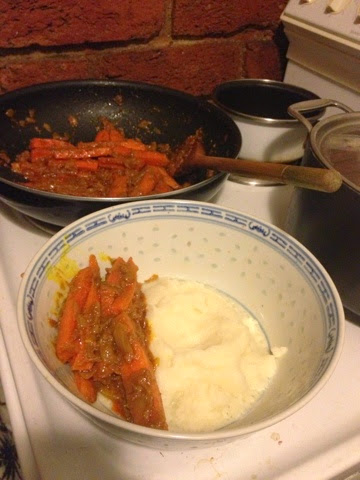
Curry paste cooked with carrots
and a side of mashed cauliflower

This recipe is still a bit rough around the edges. I received it through a friend who is of Burmese descent.

Ingredients
  • 1 Large Onion. Cut fine
  • 5-6 tbs Canola oil 
  • 1 inch ginger
  • 3 cloves garlic
  • Half teaspoon Turmeric powder
  • Optional: half teaspoon chilli powder 
  • Half teaspoon paprika
  • Half teaspoon prawn paste (can skip if you dont have this, or maybe use fish sauce instead)
  • 1 tablespoon crushed dried prawn (I don't have this so I would just use more shrimp paste)

Method

Crush Ginger and garlic is crushed in mortar and pestle to a paste. Start cooking onion and oil first until soft. Then add ginger garlic, turmeric and chilli 

Add paprika, prawn paste, and dried prawn last as it burns.


Use this curry paste and cook with any of the following:
  • eggplant
  • eggs
  • pumpkin
  • laksa - you can make a kind of laksa by adding coconut cream, chilli, konnyaku noodle, and prawns


Tuesday, 10 June 2014

I have Natto !

My kind Korean neighbours gave me some Natto to try. This is basically fermented / cultured soy beans, and it is really good for gut and immune health. Well known for its benefits in preventing heart disease. My neighbour says people also use it to treat diabetes. They suggested mixing it in with yoghurt - I tried doing that and it masks the smell and texture very well.